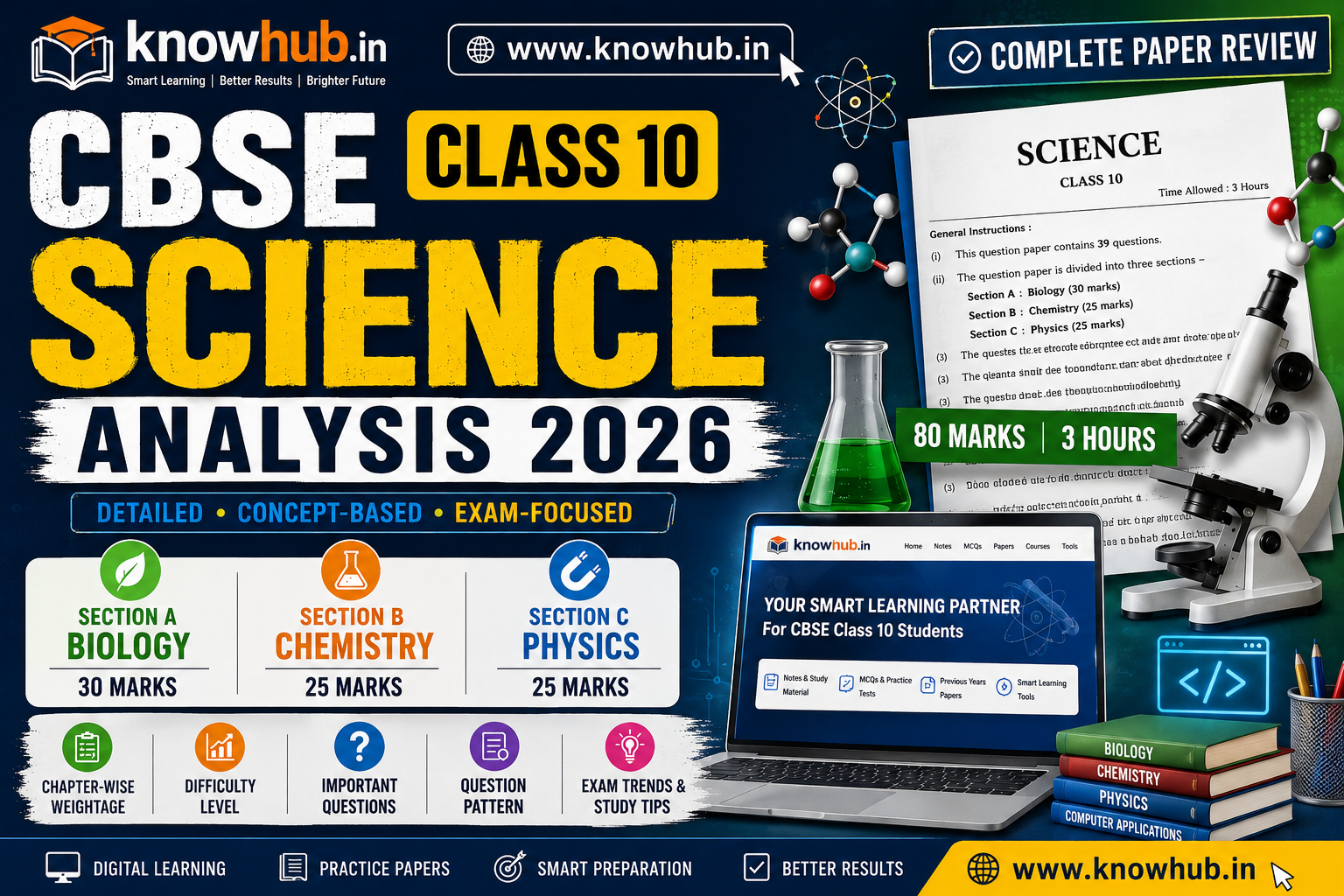
CBSE Class 10 Science Analysis 2026: Complete Chapter-wise Weightage, Question Pattern and Important Topics
The CBSE Class 10 Science board examination is one of the most important papers for students because it combines Physics, Chemistry, and Biology in a single subject. Students often ask:
- Which chapters carried more marks?
- Which type of questions were asked?
- Was the paper difficult?
- Which NCERT topics appeared directly?
- What should students study for upcoming exams?
After analyzing the complete CBSE Class 10 Science paper, we found several important patterns that can help students understand the examination strategy and prepare more effectively.
Overall Paper Structure
The theory examination carried:
Total Marks: 80
Time: 3 Hours
The paper was divided into:
| Section | Subject | Marks |
|---|---|---|
| A | Biology | 30 |
| B | Chemistry | 25 |
| C | Physics | 25 |
The paper contained:
✔ MCQs
✔ Assertion–Reason questions
✔ Short answer questions
✔ Long answer questions
✔ Case-based questions
✔ Diagram-based questions
✔ Numerical problems
Science Analysis – Difficulty Level
| Level | Percentage |
|---|---|
| Easy | 35% |
| Moderate | 45% |
| Difficult | 20% |
Overall difficulty:
⭐⭐⭐⭐☆ (Moderate)
The paper was not heavily memory-based. CBSE focused more on:
- Understanding concepts
- Applications
- Real-life situations
- Competency-based learning
Chapter-wise Weightage Analysis
Biology (30 Marks)
| Chapter | Approx Marks |
|---|---|
| Life Processes | 5–6 |
| Control and Coordination | 5 |
| Reproduction | 7–8 |
| Heredity and Evolution | 3–5 |
| Our Environment | 5 |
| Sustainable Management | 2–3 |
Major Biology Questions Asked
Life Processes
Questions included:
- Photosynthesis process
- Breakdown of glucose
- Carbon dioxide transportation
- Respiratory process
Students needed to:
- Complete pathways
- Explain processes
- Identify biological functions
Reproduction
Questions asked:
- Reproduction in Spirogyra
- Male reproductive system
- Methods of contraception
- Sex determination
Expected preparation:
Study:
✔ Asexual reproduction
✔ Sexual reproduction
✔ Human reproductive system
✔ Contraceptive methods
Control and Coordination
Questions asked:
- Hormonal regulation
- Nervous system transmission
- Brain functions
Students had to explain:
- Hormones vs nervous impulses
- Voluntary actions
Environment
Questions asked:
- Trophic levels
- Food chains
- Biomagnification
- Waste disposal
Very important observation:
Environmental questions appeared repeatedly.
Chemistry Analysis (25 Marks)
| Chapter | Approx Marks |
|---|---|
| Chemical Reactions | 2 |
| Acids Bases and Salts | 2–3 |
| Metals and Non-metals | 7–8 |
| Carbon Compounds | 8–10 |
| Periodic Classification | 2–3 |
Major Chemistry Questions Asked
Chemical Reactions
Questions:
- Combination reactions
- Heating Ferrous Sulphate
Students needed to:
- Identify reaction type
- Write equations
Metals and Non-Metals
Questions included:
- Soft metals
- Extraction of metals
- Amphoteric oxides
- Reactivity series
Study focus:
✔ Reactivity series
✔ Metal extraction steps
✔ Properties of metals
Carbon Compounds
This chapter carried heavy weightage.
Questions included:
- Ethanol reactions
- Esterification
- Benzene
- Covalent bonding
Important topics:
✔ Functional groups
✔ Ethanol
✔ Ethanoic acid
✔ Soaps and detergents
✔ Carbon bonding
Physics Analysis (25 Marks)
| Chapter | Approx Marks |
|---|---|
| Light | 6 |
| Human Eye | 7–8 |
| Electricity | 5–6 |
| Magnetic Effects | 6–7 |
| Energy Sources | 2 |
Major Physics Questions Asked
Light
Questions included:
- Magnification
- Lens formula
- Refractive index
Students had to:
- Perform calculations
- Use formulas
Human Eye
Questions:
- Myopia
- Eye lens adjustment
- Scattering
Expected skills:
✔ Diagram understanding
✔ Numerical solving
Electricity
Questions included:
- Ohm’s Law
- V–I graph
- Resistance calculations
- Heating effect
Magnetic Effects
Questions included:
- Magnetic field around conductor
- Fleming’s Left Hand Rule
- Electromagnets
Type of Questions Asked
| Question Type | Approx Number |
|---|---|
| MCQ | 14–16 |
| Assertion–Reason | 3 |
| Short Answer | 8–10 |
| Long Answer | 5–6 |
| Case Based | 2 |
| Numerical | 4–5 |
Question Design Pattern Used by CBSE
After analysing the paper, CBSE appears to follow this structure:
Step 1
Direct concept questions
Example:
“What is trophic level?”
Step 2
Application questions
Example:
“Explain why variation is useful.”
Step 3
Case-based questions
Example:
Questions based on practical situations and experiments.
Step 4
Diagram and numerical questions
Students had to:
- Draw
- Calculate
- Interpret
Important Observation from the Paper
Biology
Repeated concepts:
- Reproduction
- Environment
- Hormones
Chemistry
Repeated concepts:
- Carbon compounds
- Metals
Physics
Repeated concepts:
- Lenses
- Electricity
- Magnetism
What Students Should Study Now
Highest Priority
Biology
✔ Reproduction
✔ Life Processes
✔ Environment
Chemistry
✔ Carbon Compounds
✔ Metals and Non-metals
Physics
✔ Human Eye
✔ Electricity
✔ Magnetic Effects
NCERT Focus Areas
Students should not skip:
- NCERT examples
- NCERT in-text questions
- NCERT activities
- NCERT diagrams
- NCERT exercises
Many board questions are directly modified from NCERT.
Final Verdict
The CBSE Class 10 Science paper was balanced and competency-focused. Students who depended only on memorization may have struggled because many questions required:
- Concept understanding
- Logical thinking
- Application skills
- Diagram interpretation
Students who thoroughly practiced NCERT, sample papers, assertion-reason questions and competency-based questions would likely find the paper manageable.
For future aspirants, preparation should focus less on rote learning and more on understanding concepts and applying them to new situations.
Want to learn something new? Click here.